Writer: FairyGothMother
Welcome to the Celestial Star – your exclusive inside look at all things happening at Celestial Studios! Each month, we’ll bring you a Kinky Articles and Conversations, updates with the latest studio buzz: from upcoming events and private hire opportunities to special offers and creative projects we’re working on. Whether it’s a new workshop, an event, or an exciting collaboration, you’ll get a sneak peek into what’s next. Stay connected to be the first to know and never miss out on the exciting happenings here at Celestial Studios.
Imagine tying a rope around a sack of rice and, unknowingly, laying the foundation for a practice that would one day become a global art form. In medieval Japan, rope—nawa—was as essential as rice itself. It was used to bundle straw, secure loads, fasten armour, and hold daily life together. But somewhere between function and tradition, a transformation began. What started as practical became symbolic, and what was once restraint became expression. Welcome to the intricate, fascinating world of Shibari.
Shibari, which simply means “to tie,” is the contemporary name given to the Japanese art of rope bondage. It’s also known as kinbaku—meaning “tight binding.” But these translations only hint at the richness of the practice. For some, Shibari is a performance art. For others, it’s an intimate ritual, a meditation on trust, vulnerability, and human connection. However you define it, Shibari is more than just knots. It’s a centuries-old tradition steeped in symbolism, aesthetics, and deep emotional resonance.
The roots of Shibari stretch back to the Edo period (1603–1868), a time of peace, rigid social order, and visual refinement in Japan. During this era, law enforcement was largely carried out by the samurai class, who developed a method of restraining prisoners called hojōjutsu. Unlike the shackles and cuffs used in the West, hojōjutsu relied on rope and complex tying techniques to capture and immobilize suspects.
But these ties weren’t purely functional. They were designed with purpose and meaning. A person’s status, gender, and the nature of their crime influenced how they were bound. High-ranking prisoners might be tied with care and respect, while others were displayed more publicly, with knots that shamed or humiliated. Even the presentation of the ropes—clean, symmetrical, deliberate—mattered. Binding was, in many ways, a language. It communicated guilt, authority, and hierarchy without a single word.
The influence of hojōjutsu lingers in Shibari to this day. Many of the traditional ties, such as the ushiro takatekote (a classic box tie with arms behind the back), evolved directly from these martial techniques. The precise structure, the discipline in form—these are echoes of a time when rope was as much a tool of justice as it was a canvas.
By the late 19th and early 20th centuries, Japan was modernising rapidly, and with that came a loosening of strict taboos around sexuality and artistic experimentation. Rope began to appear in shunga—erotic woodblock prints—and photography, no longer as a symbol of punishment, but of pleasure, power, and aesthetic play.
One name stands out from this period: Seiu Ito. Often referred to as the “father of modern kinbaku,” Ito was a painter, writer, and photographer whose work blurred the lines between history, fantasy, and erotica. Deeply inspired by hojōjutsu, he began experimenting with bondage scenes in his art, depicting women tied in classical poses, often suspended, sometimes contorted, always composed with meticulous attention to detail.
Ito was controversial in his time, and still is today. His work explored both erotic and violent themes, and his models were often shown in scenes that challenged the boundaries of taste and consent. Yet his legacy is undeniable. He treated rope as art, documenting the emotion, tension, and beauty of every tie. In doing so, he helped move kinbaku from the shadows of taboo into a form of aesthetic expression.
“I’m not a pervert,” Ito once said in response to public criticism. “I just love the beauty of rope on skin.”
After World War II, with American occupation came both censorship and curiosity. Shibari found itself pushed underground—but it never disappeared. In Tokyo’s postwar era, a quiet renaissance of rope began to flourish in nightclubs, adult magazines, and secret gatherings. Artists and performers began developing new styles of bondage that were less about restraining the body and more about showcasing it.
By the 1950s and 60s, the term kinbaku-bi—the beauty of tight binding—had come into common use. This phrase captured something essential: that Shibari was not merely about control or submission, but about composition, contrast, tension, and flow. The body became a sculpture. Rope became the medium.
Masters like Akechi Denki and Nureki Chimuo continued to develop the art, publishing works, teaching apprentices, and helping to shape a modern vocabulary of rope. As Japan relaxed censorship laws in the 1970s and 80s, Shibari began to appear more openly in adult films, art books, and theatre. It was no longer hidden—it was celebrated.
Today, Shibari has truly gone global. You’ll find rope workshops in Berlin lofts, performance art in British clubs – (particularly one in Derby…) and online communities in every language. It’s practiced by couples in their bedrooms and by professionals on stages. Some people approach it as a form of meditative practice. Others as erotic play. And for many, it’s both.
In recent years, the aesthetic appeal of Shibari has been embraced by the fashion world, photography, and contemporary art. Rope artist Hajime Kinoko, known for his intricate red rope installations and striking body suspensions, has collaborated with designers and exhibited in galleries across the world. His work, and that of many like him, presents Shibari not just as kink—but as couture, as sculpture, as philosophy.
But beneath the spectacle and sensuality lies something deeper. Ask any seasoned rope practitioner what Shibari means to them, and the answers are often intimate and emotional.
“Shibari is about more than rope,” one practitioner said. “It’s about what happens between the knots. The space between trust and tension. The shared breath.”
To understand Shibari is to appreciate a history woven from many threads—discipline and desire, utility and artistry, rebellion and ritual. From samurai-era police work to avant-garde photography, from shadowed parlours to centre stage, the journey of Shibari reflects the ever-shifting dance between control and surrender, tradition and transformation.
And while the ties themselves may appear intricate or even intimidating, the essence of Shibari remains simple. It is an act of presence. Of attention. Of intentional connection.
So next time you see a length of rope wrapped in elegant curves across a body—or perhaps hold one in your own hands—know this: you’re not just witnessing bondage. You’re witnessing centuries of culture, rebellion, devotion, and beauty, all woven into a single, breath-held moment.
Every knot tells a story. Every rope holds history. And in the art of Shibari, we’re still writing new chapters—one tie at a time.

Unleash your Inner Kink…
Join us for the ultimate kink experience as we embark on our second Fifty Shades of Play party this year! the theme this month is RED LIGHT DISTRICT! This event is designed for the curious, the adventurous, and the bold, offering a safe, sexy, and welcoming space to explore your deepest desires.
Are you ready to add a dash of the forbidden to your nightlife? Step into a realm where your deepest desires are not just whispered about, but celebrated.
This is your golden ticket to explore the thrilling landscape of kink and fetish, all within a vibe that’s as electrifying as it is inviting.
Whether you’re a seasoned player or just dipping your toes into these deliciously deep waters, ‘Fifty Shades of Play’ is the place to be. Let your inhibitions dissolve as you embrace a night of discovery and sensory delight.

A Night for the Curious, the Adventurous & the Pleasure-Hungry… we’re calling on the greedy girls, the hung boys, the size queens and the kinky couples – this night is for you to
SHAFT OR GET SHAFTED

Open to all genders, orientations, shapes and sizes! Perfect for performers wanting to update their photos and showreels, rope enthusiasts to take beautiful images, professional service providers and private/amateur individuals and couples who would like to have some photos taken for their own private use. We are also looking for Photographers who would like to join the CS Family. These shoots will take place twice per month.
MAY CONFIRMED PHOTOGRAPHERS:
Paulina Czochra – Boudoir Specialist
Joseph Robert – Latex and Fetish Specialist





Intro & Origin Story
1. Can you tell us about the first time you were introduced to
rope? What was it that clicked for you in those early
moments?
I was first introduced to ropes through the photo shoot project with Katarzyna Konarska, in Krakow. She asked me, if I would like to try something different, something called “shibari”. She showed me reference pictures by Noboyushi Araki, and of course I agreed.
What I remember the most was the smell of ropes, it was hemp, that reminded me of horses and my teenage years of hanging out at the stables. Second thing was the little rope dust in the air when rigger (Hakan) was untying me.
What clicked for me was also the moment of restriction, that didn’t actually like something bad, but as something freeing. It made me feel like I have more movement in the restriction, then when I am not bound by ropes. I don’t know how to explain it better, but it just showed me more possibilities of moving in the way I didn’t know before.
2.You started as a model and quickly moved into tying and
eventually self-suspension — was that a natural evolution
or more of a leap into the unknown?
It was absolutely natural evolution, I didn’t plan any of it. I was just saying yes to opportunities when they came along, and I enjoyed (and still do) the process.
Art Meets Kink
3. Your performances are such a striking blend of art, kink,
and story. Do you see your work as performance art,
ritual, kink, or a mix of everything?
Definitely mix of everything, all of the above – ritual, kink, our life stories – all of those are pure art. I studied physical theatre, general drawing and painting, aerial arts, lighting for theatre, pyrotechnics, and spent over a decade in the kink community, teaching and performing, and it feels impossible to separate all of these things. They come to me naturally and are always part of my creations.
4.There’s a real intensity to self-suspension — both visually
and physically. What kind of headspace do you get into
before a performance?
It’s difficult to say, as it really depends on the environment, the subject of the performance, my life situation etc. What I can say is that each time I perform I use it as personal therapy, I can let out emotions that are brewing in me, and via the medium of performance I can let those out in a safe way, where I know that audience is holding me.
Style & Process
5.Your dynamic style of self-suspension is instantly
recognisable. What inspired you to develop this particular
way of moving and performing in rope?
I have no idea. Sometimes I feel like it developed naturally when I was rushed to the stage without enough time to get ready, or was given shorter time on the stage, but I wanted to show all the moves, so I started going faster and faster hahahah.
6.Do you plan your performances ahead of time like a
script, or is there room for improvisation and instinct on
the day?
Both. For theatre performances it is very well structured, planned, scripted. For other events, like kink spaces, I also have a story behind each performance, but I leave myself at least 10% room for improvisation. I always know how I start and how I want to finish, and in between I let myself be present on the stage and feel what comes my way, and let it move my body and ropes.
Empowerment & Embodiment
7. Self-suspension is such an act of strength, skill, and trust
in your body. What does empowerment look like for you
within rope?
It’s that freedom of deciding how tight the ropes will be, how many of them will bound my body, how much I can challenge myself, or how much I will let go, as well as how soft I can be for myself if needed in the moment. It’s trusting your body and your instincts.
8.You’ve described your shows as provocative and
empowering — are there particular messages or emotions
you like to explore through your performances?
I like when audience can decide for themselves what they feel when they experience my performances, hence why I try not to give titles or briefs to my performances, to do not suggest anything, but let people feel what they want to feel.
Community & Culture
9. You’ve worked with legends like Kinoko Hajime and Saki
Kamijoo. What’s something you’ve learned from
collaborating with other big names in the rope world?
Patience, respect to the history of this artform, respect to previous masters who enabled us to practice ropes in the shape they are now, and precision.
10.You’ve performed all over — from Tokyo to Amsterdam
to the Seychelles! How do different audiences or cultures
respond to your work?
That’s a great question! It’s different in each place! I’ve been in too many, to describe each one of them, but for example, in Tokyo, the audience is extremely respectful. Those who are at the front will sit on the floor, so those behind them can see the stage. When you perform, the audience is silent and won’t film anything on their phones, but actually be very present and mindful. At the end, there is an applause, but no one screams or cheers. Almost everyone after I finished performing would try to thank me in person.
In Poland, on the other hand, they scream and cheer during and after the performance, and won’t let you get off the stage, and be asking for more! Like at a rock concert!
11.Have you ever encountered misconceptions about self-
suspension — either from within the kink community or
outside of it?
Yes, in both. A lot of people who are from the outside of the kink community, think that I do self-suspension because I like pain, or that I am a masochist. And make strong assumptions about my preferences. In kink community not so much, but still happens sometimes that people think I am a Domme, because I don’t get tied up, and they assume I must be sadist, masochist as well as dominant.
It’s very interesting to see that sometimes.
The Personal & the Practical
12.What are some of the rituals or self-care routines you have
around suspension, especially after a demanding show?
Biggest self-care routine is to cook something comforting for myself when I get back home, or if I can’t go straight home after performing, I try to find green space, like city park, small forest, meadow, to be surrounded by nature. And cuddles with animals that I meet on my way.
13.Rope injuries and fatigue are real. How do you care for
your body as a performer, and how do you know when to
rest?
Hot baths with epsom salts and magnesium flakes, yoga, stretching, and going regularly for sports massage. I also take supplements such as collagen, vitamin D, magnesium. I eat lots of veggies and fruits.
Looking Ahead
14.You’ve been part of Torture Garden’s main stage lineup
since 2015 — what’s kept you inspired to keep
performing all these years?
Oh, inspirations happen on a daily basis. I get inspired by nature, folklore, music, films, paintings, emotions, life events. The list is never ending! 😊
15.What excites you most about where self-suspension and
rope performance are heading as an art form?
I love that people from different disciplines are starting to get into ropes and they bring their own touch to this artform. It’s exciting to see combination of other aerial disciplines being mixed in self-suspension.
16.Any dream projects or collaborations you’d love to make
happen in the future?
Not really, I am excited about every collaboration that comes my way, and I am grateful for each one of them.
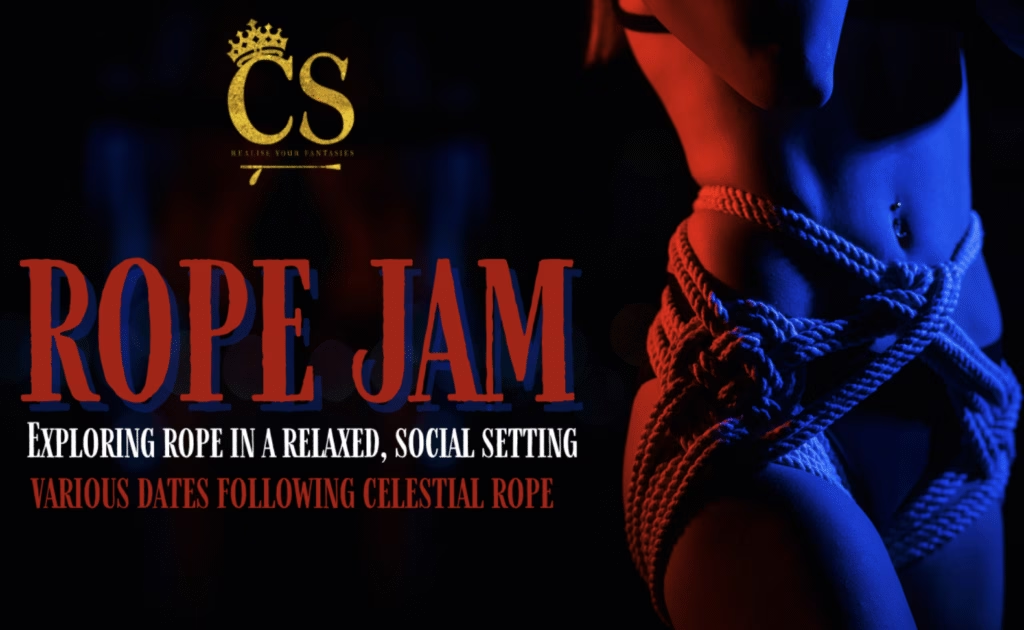
You can catch Skinny Red Head performing at Fifty Shades of Play on 24th May. She will also be teaching Rope Workshops at CS on 25th May

We’re thrilled to offer our members an exclusive rate on room hire of The Fantasy Suite and The Office. We are offering a huge reduced rate of only £30 per hours – available to membership holders only!
Simply use code ‘MAYHIREOFFER30’ when you book to claim your special rate.
